
Founder Burnout
When doing everything stops working
From founder dependency to leadership leverage

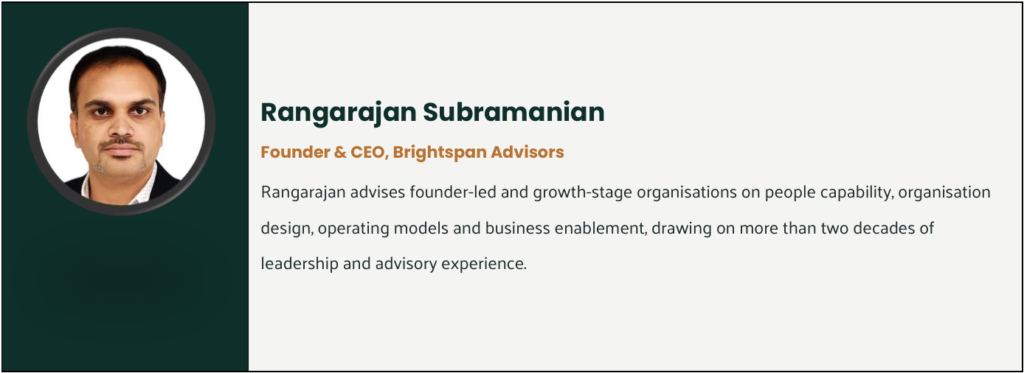
Rangarajan Subramanian
Founder & CEO, Brightspan Advisors | September 2026
EXECUTIVE PERSPECTIVE
The founder’s strength can become the company’s constraint
In the earliest stage of a business, doing everything is often rational. The founder sells, delivers, hires, negotiates, follows up on payments, reassures customers and makes the final call. Speed matters, resources are scarce and there may be nobody else to carry the work.
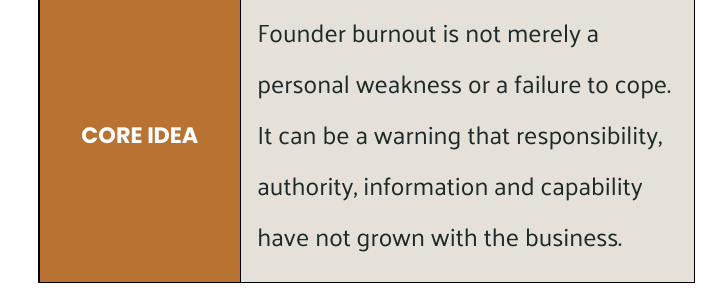
The problem begins when a survival habit becomes a permanent management system. As the company grows, the same founder who once accelerated every decision becomes the point through which every decision must pass. Work expands, recovery disappears, leaders wait for answers and the founder quietly carries more than one person can sustainably hold.
Three truths should shape the response
- Early-stage heroics are rational. They create speed, learning and customer intimacy when the venture is small.
- Growth changes the management job. The founder must move from solving most problems to designing how good decisions get made.
- Burnout can be a business-design signal. Persistent overload often reveals concentrated decision rights, thin leadership depth and weak operating rhythms.
What this article offers
- A practical definition and early-warning view of founder burnout.
- A diagnosis of the ‘I will do it myself’ dependency loop.
- A five-step operating system for shared ownership.
- A delegation ladder and 30-day reset that founders can use
- immediately.
RECOGNISE THE PATTERN
What founder burnout means
The World Health Organization describes burnout as an occupational phenomenon arising from chronic workplace stress that has not been successfully managed. It is not classified by WHO as a medical condition, and it is not a label for every difficult week. The useful signal is a persistent pattern that recovery no longer restores.
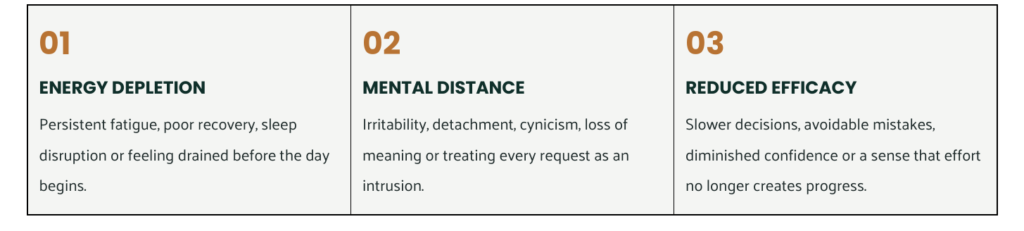
EXHIBIT 1 | WHO’S THREE DIMENSIONS TRANSLATED INTO FOUNDER EXPERIENCE
Source: (WHO)
Why founders miss it
High effort is normalised in entrepreneurship. A founder may still attend meetings, meet customers and appear decisive while operating on depleted reserves. Public functioning can therefore hide a private decline in patience, judgment, creativity and hope.

Burnout can overlap with anxiety, depression, sleep disorders and physical health concerns. Persistent or severe symptoms
deserve assessment and support from a qualified health professional; self-diagnosis is not enough.
Evidence note: This article is leadership guidance, not medical advice.
WHY IT HAPPENS
Why founders are especially vulnerable
Entrepreneurship can be deeply energising because it offers autonomy, meaning and the chance to build something important. Those strengths can coexist with unusually intense demands. Research links emotional demands with entrepreneurial burnout and identifies autonomy and job satisfaction as potential protective resources.
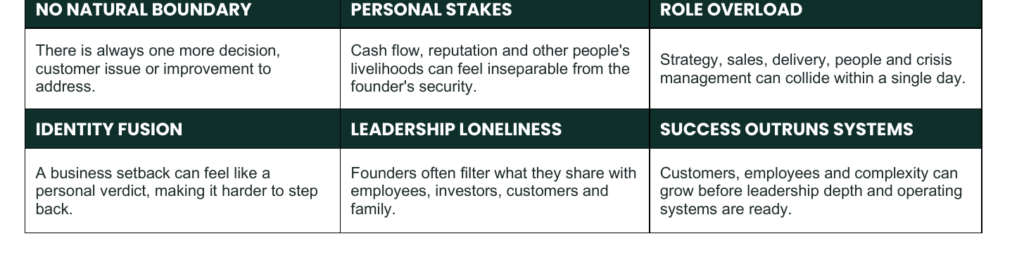
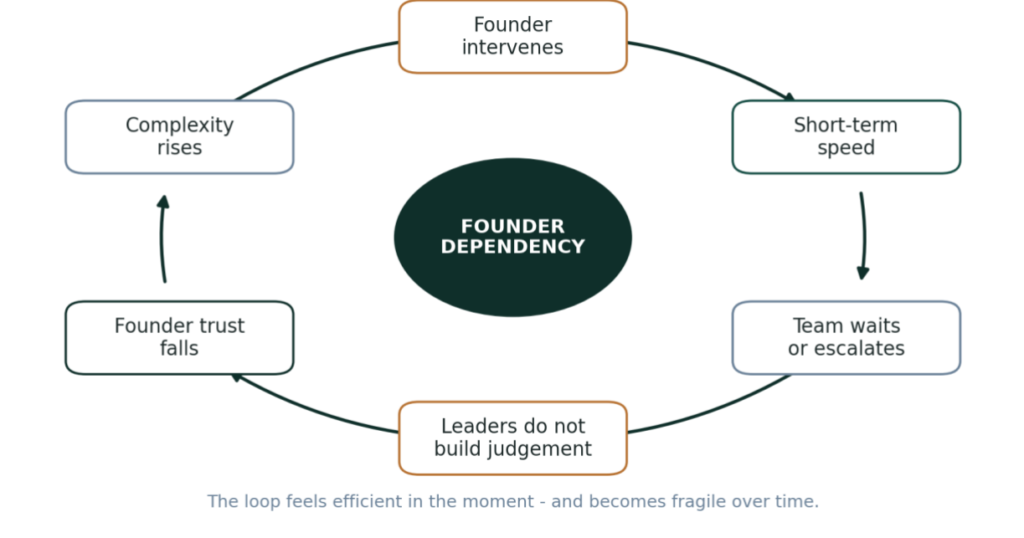
EXHIBIT 2 | THE FOUNDER DEPENDENCY LOOP
Source: Brightspan Advisors analysis.
EARLY WARNING SYSTEM
How to recognise it before it becomes a crisis
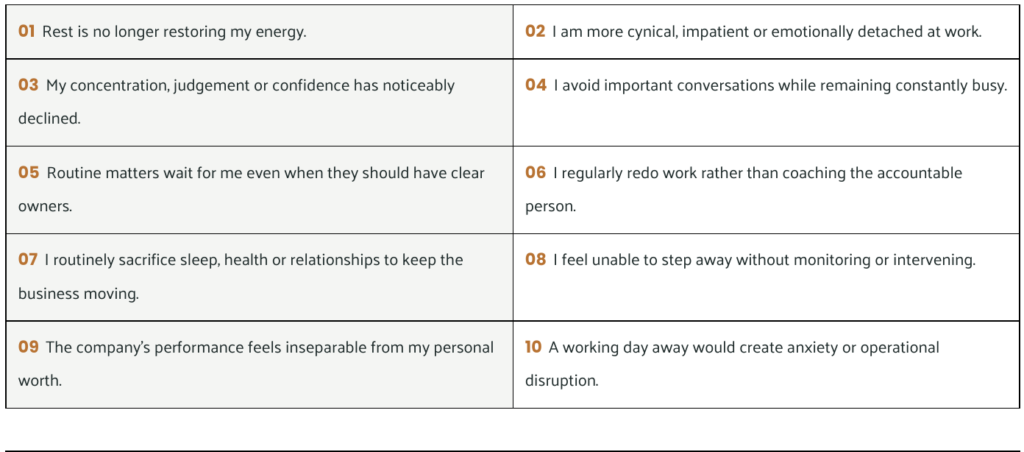
Look for a pattern across time, not one isolated symptom. Burnout becomes more plausible when several changes persist,
ordinary recovery no longer restores energy and day-to-day functioning starts to suffer.
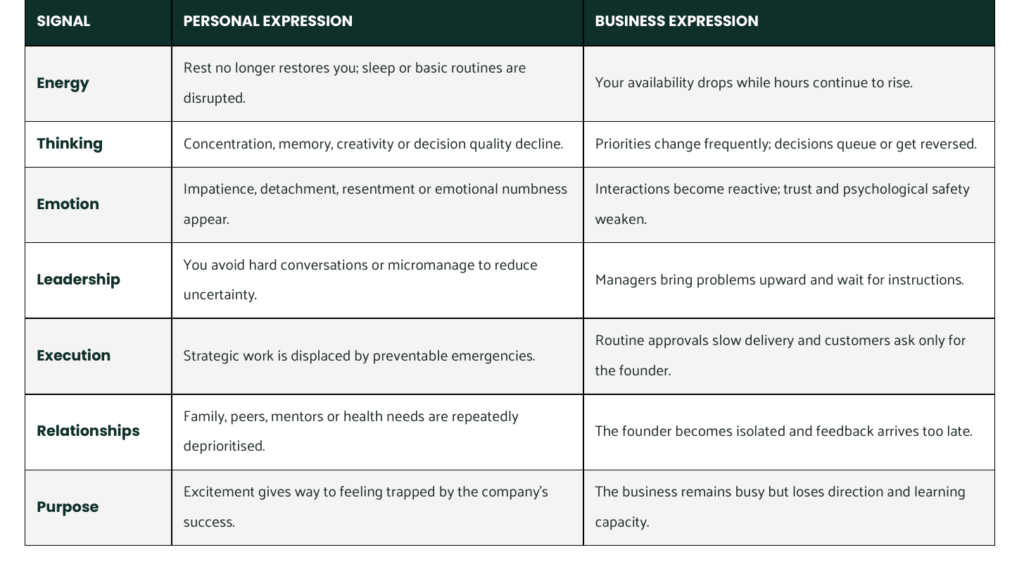

This is a reflection framework, not a diagnostic assessment. When in doubt, seek professional advice

Redesign the operating system
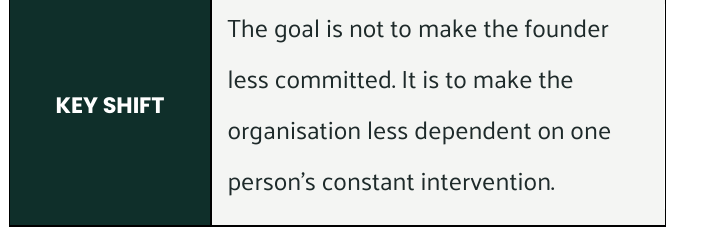
The solution is not for founders to detach from the business. It is to change the nature of their involvement — from carrying the work to building the conditions in which the organisation can carry responsibility with them.
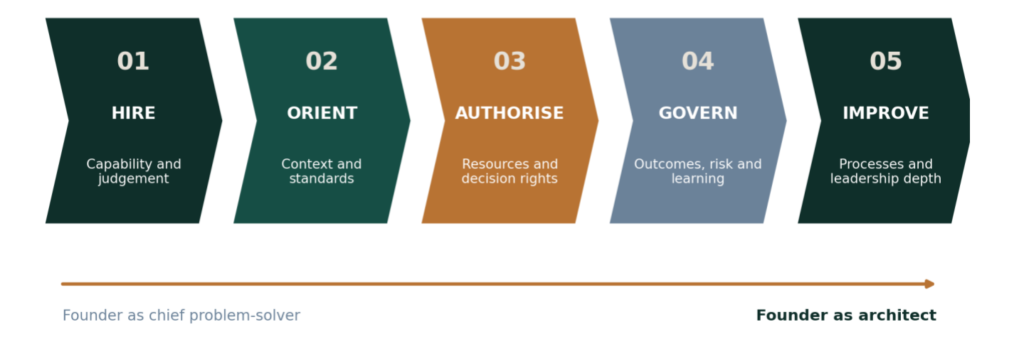
EXHIBIT 3 | A FIVE-STEP PATH FROM FOUNDER DEPENDENCY TO SHARED OWNERSHIP
Source: Brightspan Advisors analysis.

The founder’s next job is not to do more of the company’s work. It is to build the people, decision rights and operating rhythm through which the work gets done well.
BUILD CAPABILITY
1.Hire well-qualified leaders and team members
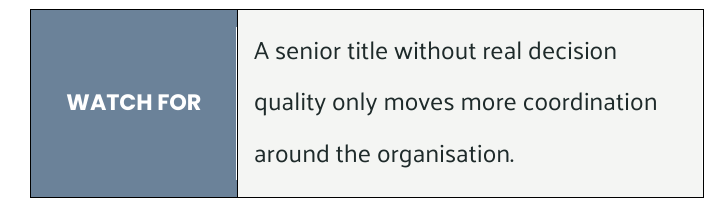
Hire for the organisation’s next stage, not only today’s backlog. Define the outcomes the role must own, the decisions it must make and the capabilities required. Look for complementary judgement rather than a replica of the founder.
Practical moves
- Use an outcome-based role scorecard with three to five measurable priorities.
- Test judgement with real business scenarios, not only experience claims.
- Be explicit about the company’s stage, constraints and ambiguity.
- Select for ownership, values fit and execution discipline not technical skill alone.
TRANSFER CONTEXT
2.Orient and train them well
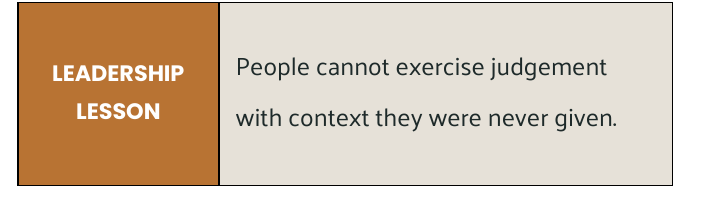
Delegation fails when founders transfer activity but keep context in their own heads. Explain the purpose, customer promise, operating principles, risks, key relationships and history behind important choices.
Practical moves
- Agree 30-, 60- and 90-day outcomes before discussing a long task list.
- Document what good looks like, including quality standards and non-negotiables.
- Use shadowing, guided practice and review – not a single information-heavy induction.
- Share the ‘why’ behind recurring decisions so the leader can generalise rather than copy.
COMPLETE THE MANAGEMENT SYSTEM
Authority, governance and learning turn delegation into scale
Responsibility only moves when the leader can act, the founder can see outcomes without micromanaging, and the organisation learns from recurring issues. The final three steps create that operating discipline.
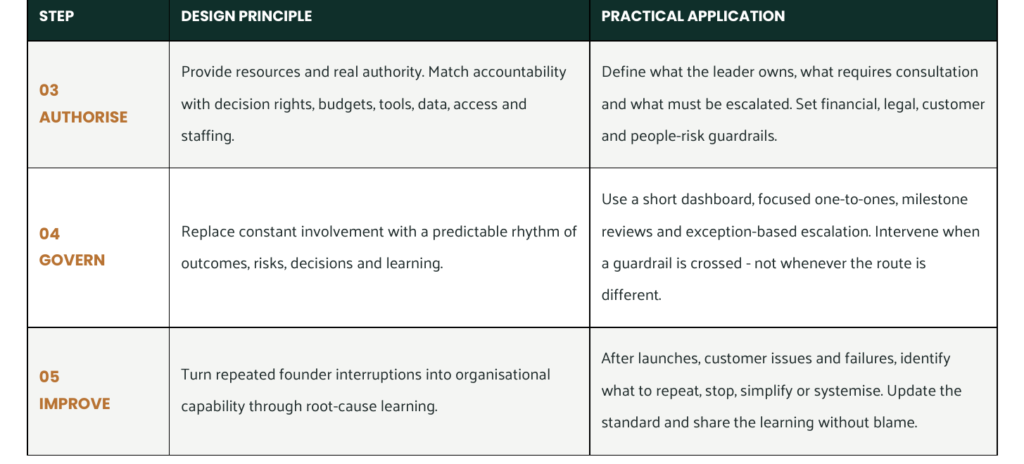
Two governance disciplines matter most
Govern outcomes, not methods. A leader can take a different route while still protecting the agreed outcome, values and
risk boundary.
Use fewer, better measures. Excessive reporting recreates the burden and slows the very ownership the founder is trying to
build.

CHANGE THE FOUNDER HABIT
The organisation can change only if the founder changes too
The five steps redesign the organisation. The founder must also loosen the personal habits that pull work back: equating control with quality, treating different methods as inferior, and feeling safer when every decision remains visible.
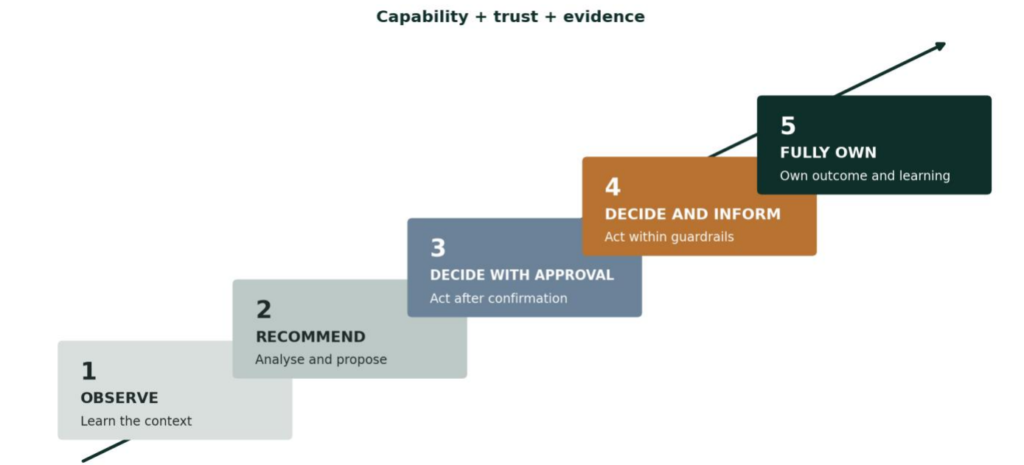
EXHIBIT 4 | BUILD DELEGATION PROGRESSIVELY
Source: Brightspan Advisors analysis.

ACTION PLAN
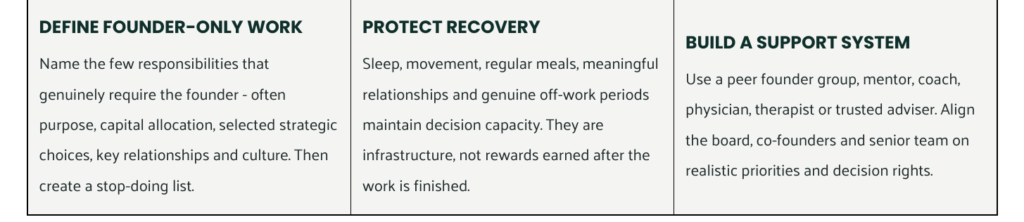
A practical 30-day founder reset
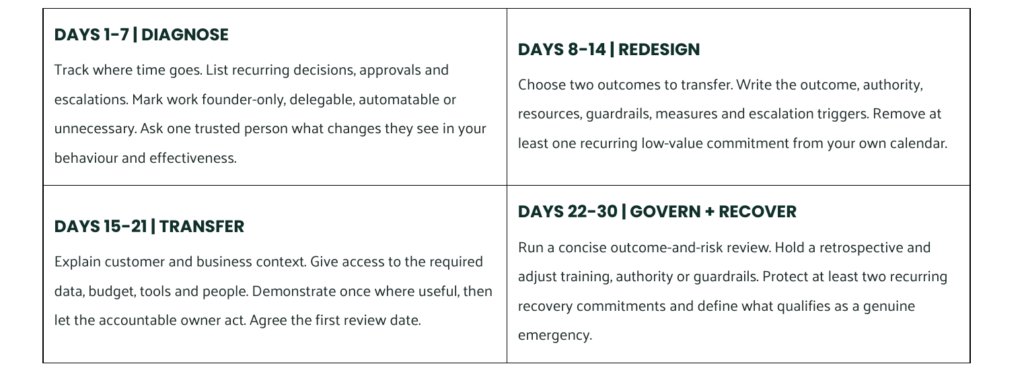
Do not begin by delegating ten small errands. Begin by diagnosing the dependency and transferring two meaningful outcomes with clear authority, support and review points.
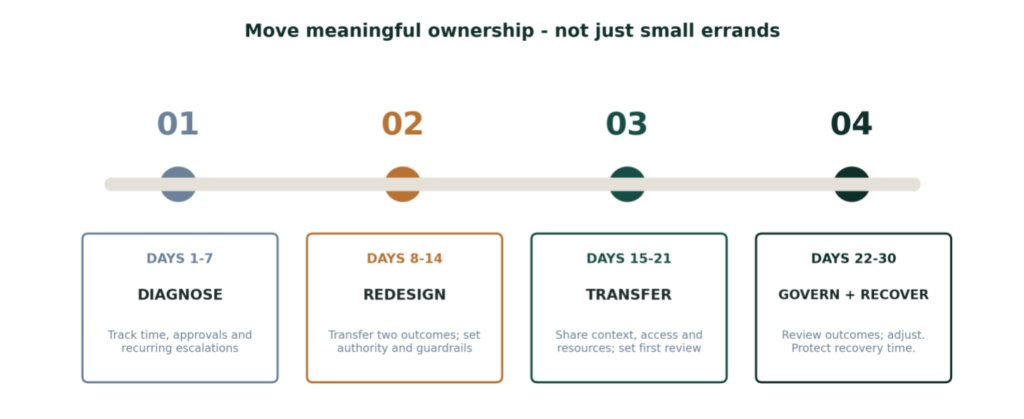
EXHIBIT 5 | A 30-DAY TRANSITION FROM DIAGNOSIS TO GOVERNANCE
Source: Brightspan Advisors analysis.

REFLECTION TOOL
A ten-minute founder self-check
Consider whether several of these statements have been true over recent weeks. This is a reflection tool, not a diagnostic or scoring instrument.

From hero to architect
Founders do not burn out because they care too much. Risk rises when care is expressed through endless personal intervention and the organisation never develops the capacity to share the load. The strongest founder is not the person who remains indispensable forever. It is the person who builds a business capable of performing, learning and growing without requiring one human being to carry it all.
ABOUT THIS PERSPECTIVE
Author
About Brightspan Advisors
Brightspan Advisors helps businesses define and govern their operating model. We bring structured thinking, independent
judgement and execution discipline to help organisations scale with consistency and confidence.
Brightspan Business Enablement Services (BES) is designed to serve as a single, trusted operating foundation, enabling founders
to run their businesses with clarity, control, and confidence from Day 1.
We take centralized responsibility for business support functions through a disciplined, governed, and scalable delivery model
INDUSTRIES WE WORK WITH
Brightspan supports organizations across diverse sectors, helping them implement scalable and compliant operating models.
Industries include:
Professional Services | Construction & Infrastructure | IT & Technology | Healthcare & Wellness | Hospitality | Education |
Retail & E-commerce | Manufacturing & Industrial

BRIGHT IDEAS. BROAD IMPACT



Leave a Reply